How to Make Your Website More Inclusive and Effective
Long ago, when my daughter was in preschool, the teachers came up with what I thought was an ingenious way to foster accessibility and inclusion among preschoolers. They introduced a mantra, of sorts, that they repeated regularly, and encouraged the children to join in: “You can’t say, ‘you can’t play [with us].’” In other words, if someone wanted to participate in an activity others were engaged in, they could—and it was up to the group to find a way to accommodate them.
Fast-forward two decades, and diversity, equity, and inclusion (DEI) are top of mind everywhere—especially among employers. No longer does it pass muster if you merely say your organization is socially responsible and that it fosters inclusivity. When it comes to DEI, it’s what you do that counts. In today’s world, your policies and practices must be inclusive, available, and accessible to all your people.
This includes your benefits website; it, too, needs to be inclusive, available, and accessible to everyone who wants to use it. Since your benefits website is where your people go for crucial information about their health, wellness, and financial benefits, how can they make informed decisions if they can’t access the information they need to make them?
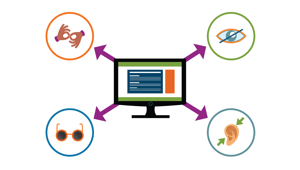
Maybe you think this issue doesn’t apply to your organization because you’ve already gone to great lengths to make your benefits site available outside your company firewall. While that’s great, it’s not the type of accessibility we’re talking about here. Web accessibility is the inclusive practice of ensuring there are no barriers that prevent interaction with, or access to, websites by people with physical, cognitive, and situational disabilities, or socioeconomic restrictions on bandwidth and speed.
Yes, the accessibility arena is vast, but you can make serious inroads just by ensuring your site is accessible to employees with physical disabilities, such as visual impairment. In doing so, you’re also improving the usability of the site for all users.
The power of the Web is in its universality. Access by everyone regardless of disability is an essential aspect.
– Tim Berners-Lee, Creator of World Wide Web
The Cold, Hard Facts
More than a quarter of all adults in the U.S. are living with some sort of disability—4.6% are blind or have serious difficulty seeing, and 5.9% are deaf or have serious difficulty hearing.
Since only 1% of the top million home pages on the web are accessible, it’s likely your organization’s benefits website isn’t. This means that some of your people cannot use it. Even if no one's mentioned having trouble using your site, it doesn't mean they aren't.
The Americans with Disabilities Act (ADA) is one of the laws that governs accessibility in the U.S. Also important is Section 1557 of the Affordable Care Act, which prohibits discrimination in access to benefits based on health status. Accessibility is required for both consumer-facing websites and websites used by your employees for accessing their work-related benefits.
Increasingly, employees are holding the C-suite’s feet to the fire when it comes to improving diversity and inclusion. The whistleblowers at Google may have started the trend, but employees everywhere have picked up their mantle. And they’re not backing down. With digital accessibility lawsuits on the rise, what can you do to ensure you’re not next on the docket?
At the very least, your benefits website should meet federal electronic and information technology accessibility requirements. Not only is it the right thing to do, but several federal and state laws require it. And even if you’re not required by law to do it, there are compelling business reasons for it. Social responsibility has become a priority for the stakeholders you need in your corner—investors and employees.
It’s not just about disabled users being able to access your website—it’s about everyone being able to access your website.
– Trenton Moss, Owner, Webcredible Consultancy Firm, UK
Making a Website Accessible
To make a website accessible for all users, developers use resources like the web accessibility guidelines created by the Web Accessibility Initiative of the World Wide Web Consortium (W3C). Since the guidelines address users with disabilities of many types (visual, auditory, motor, cognitive, and seizure and vestibular disorders), they can be daunting if you’re addressing your benefit site’s accessibility for the first time.
In this case, for most employers, a good place to start is with ensuring content is accessible to screen readers, which are used by those who are visually impaired. Screen readers are software programs that use a speech synthesizer or Braille display to allow blind or visually impaired users to read content displayed on a computer screen.
4 Areas of Focus for Visually Impaired Users
Here are 4 features you can target to make your website more accessible to people with visual impairments:
1. Page structure
- Use semantic HTML tags. They describe the content and structure of your page and allow the screen reader to move quickly to the section of content they’re looking for.
- Add headings to organize page content. This allows the screen reader to read the structure of the page.
2. Images and design
- Choose colors that guarantee a high contrast between text and background or background images.
- Include alternative text for images (known as alt text) for non-decorative images that provide information or context (e.g., graphs and charts, infographics).
- Use focus outlines. They add a border around the active or selected item on a web page, making it more visible to the user.
- Add captioning to videos. This allows the screen reader to capture all non-auditory content.
3. Links
- Add a skip link to the top of your web pages. This allows the screen reader to skip items that are displayed on every page, such as the navigation.
- Use descriptive hyperlinks so the screen reader knows where it’s taking them. For example, instead of “review this document,” write “review our Leave of Absence Guide for New Parents.”
- Add anchor links to the top of long pages. This enables the user to skip to the content they’re looking for, instead of listening to the screen reader review all the content that precedes it.
4. User experience and navigation
- Make sure all menus are accessible via keyboard. The user should be able to use the keyboard—not just a mouse—to navigate through your entire website.
Whether you’re designing a new benefits website or upgrading the web experience you currently offer your people, you’ll be off to a good start in creating an inclusive, accessible site by taking the steps above. For a deeper dive into accessibility, visit W3C and WebAIM.
We're proud to work with organizations that value their people. If you want to learn more, we’d love to talk.
This blog was co-authored by Stacey Simon, Senior Consultant.
Read Next
Work with Us
We partner with organizations that value their people first. Let’s talk.