
Start working. Start saving for retirement. Increase the percentage you’re saving as you go. Retire. Be happy. That has been the defining story of financial security we have been telling employees for years. And yet, lately it feels more like a fairy tale.
Financial stress affects every aspect of your employees’ well-being and workplace performance. Today, it’s impacting more people in even bigger ways, worsening employees’ physical and mental health and decreasing their productivity. Many HR and benefits professionals know this well and have put financial well-being programs and communications in place to help.
However, what we’ve seen across hundreds of organizations is that financial well-being communications are often technically accurate but emotionally misaligned. They’re built for rational decision-makers, not stressed humans, and they’re often framed around traditional or outdated concepts of financial security.
When financial well-being or retirement program participation falls short of expectations, research shows it’s rarely due to the employees’ lack of awareness or understanding but is due to other factors, like the perception that the offerings don’t address their needs.
Clearly, there is a gap between employees’ financial needs and their actions. (Telling employees to skip their daily latte won’t close it, unfortunately.) Instead, focus on repositioning your messaging and communications to be more authentic, empathetic, and relevant to the unique values and experiences of your workforce.
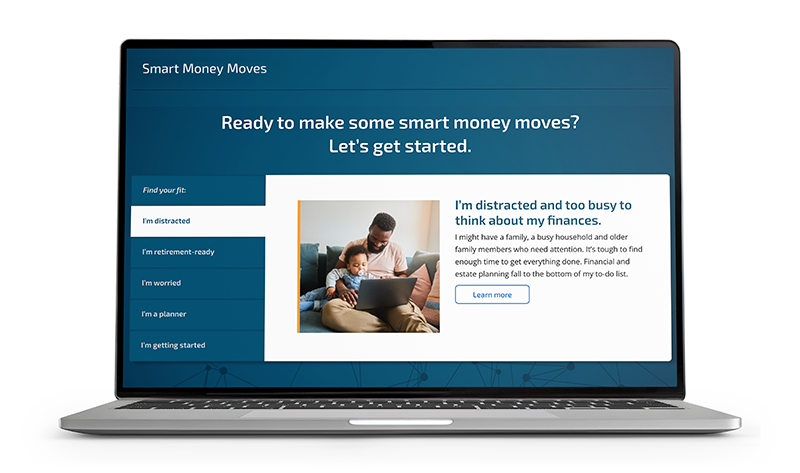
Targeted Smart Money Moves campaign based on life stages
Why Your Messaging Needs Remixing
The current story of the path to financial security assumes certain starting and ending points that are not as universal as they once were. We currently live in a multigenerational workforce, the most diverse in terms of age groups in recent history.
The modern workforce is navigating unprecedented external challenges, with financial strain increasing across demographic groups. Student debt is affecting those just entering the workforce, while Generation X employees face pressures on all sides from rising childcare costs and eldercare responsibilities. For many millennials, the high cost of living continues to be a major barrier to financial progress, And, yet, a one-size-fits-all narrative continues to show up in communications.
Depending on where they are in life, each employee may have different needs and values around financial topics. Only 25% of employees are on track for retirement, so learning that they can increase their match to their 401(k)s is probably not going to resonate with the other 75%. Fifty-seven percent of employees live paycheck to paycheck, and 31% of employees have less than 1 month of emergency savings, so you can imagine how getting in touch with a financial planner is probably not their first priority.
What Really Resonates
A lot, actually.
Recognize and understand your people’s priorities.
Start by understanding where your people are in their lives and what keeps them up at night. Understanding starts with listening. Anonymous surveys and focus groups can help HR teams uncover concerns that employees hesitate to share openly, and they can shed light on challenges that might be otherwise overlooked.
One of our public sector clients did just that. We hosted a virtual focus group to gather employee feedback about the information they were seeking and their knowledge around financial well-being. We asked questions ranging from “Tell us how you hope to spend your time during retirement,” to “Please tell us what a defined benefit plan is.” The beauty of the AI-enabled research platform we use is that we can ask follow-up questions based on people’s responses. And if people can’t make it to the live session, we can always set up an asynchronous session.
Personalize your communications.
Now that you understand your employees’ starting points, you can align your communications with major life events that your people are experiencing or may experience soon—things like establishing a savings account for the first time, buying a home, having a child, and so on.
One of our national defense contractor clients decided to take on this approach. Instead of overwhelming employees with a single, one-size-fits-all microsite, we created one that meets everyone based on life stages. Employees are prompted to identify which description best matches their current situation—from “I’m just getting started” to “I’m worried” or “I’m retirement-ready”—and then they’re guided to content and benefits that align with that reality. Rather than being told what they should care about, employees see information framed around what actually matters to them, making the experience feel relevant instead of patronizing.
Emerging technologies, such as AI, can also help personalize financial well-being communications at a larger scale, without losing that human touch. They can tailor messaging, find relevant resources, and adjust tone—so people receive information tailored to them, not what a generic campaign provides.
Focus on whole-person well-being, and offer practical solutions.
As you’re personalizing your communications, take the time to consider each call to action. Avoid focusing too heavily on long-term savings, such as retirement, when people have short- and mid-term goals that could directly affect their quality of life right now.
Emphasize building emergency savings, so employees can handle unexpected life events without having their financial goals derailed.
Create financial literacy programs that can educate your people on general financial concepts and show them the real-life applications of your programs. Sprinkle every financial benefit you may have in there. No matter how small you may think the program is, it could really make the difference in your people’s lives.
One of our tech clients has a very educational-forward benefits website. But they decided to move beyond abstract education by designing content around concrete, actionable goals. When it came to their financial education, instead of leading with jargon, we organized the experience around common money challenges: saving automatically, reducing debt, preparing for retirement or planning for a family. Each goal connected employees directly to the specific tools, benefits, and next steps that could help them make progress right away. The story was clear, practical, and grounded in their daily lives.
Change the Story, Improve Lives
The story of the path to financial security shouldn’t be out of touch with the real lives of your people. Employees want employer support in becoming—and staying—financially secure. Write a story that your people can see themselves in. When you design your financial well-being communications to make employees feel seen, understood, and supported, they’ll start to believe in it again.
Read Next